 |
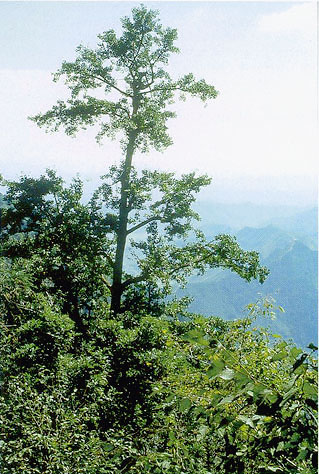
Photo left:
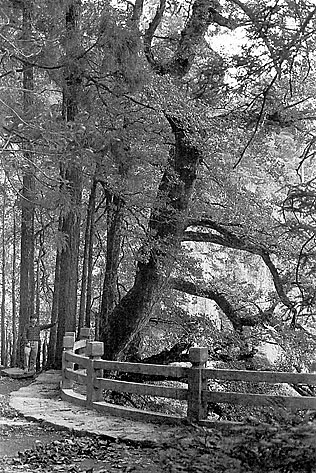
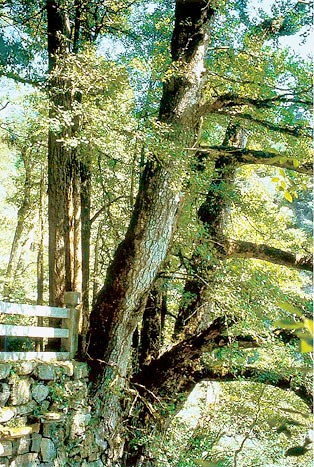
Ginkgo biloba on the edge of the Tianmu Shan Reserve (province Zhejiang) in China. Height about 30 m, 108 cm (diameter at breast heigth). Photos below:
|
 |
 |
Ginkgo biloba trees are on the
UNEP-WCMC List of Threatened Species.
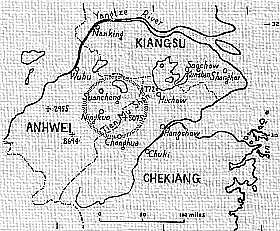
circle: Tianmu Shan Reserve
Tianmushan Biosphere Reserve
is located in the Zhejiang Province in the eastern coastal region of China,
about 230 km south-west of Shanghai. Also known as the ‘kingdom of big
trees’, the biosphere reserve protects ancient wild Ginkgo biloba communities.
Tianmushan has a long history of human activities dating back more than
2,000 years ago. Buddhism, Taoism and Confucianism were practiced over
centuries and have contributed to the conservation of nature in the region.
There about 244 Ginkgos grow mostly on stream banks, steep rocky slopes
and the edges of exposed cliffs. Many are multitrunked, with at least two
trunks, caused by damage experienced from soil erosion or other factors
that stimulated root-like "basal chi-chi" at the base of the trees which
is a very important factor in explaining the long term persistence of the
Ginkgo in this Reserve.
About 10% of the Ginkgos in
the Tianmu Shan Reserve is estimated to be over 1000 years of age.
The Ginkgos' mean diameter in
the Reserve at breast height is 45 cm, mean height 18.4 m.
Non-Chinese populations are all
genetically close to this eastern lineage, indicating multiple human-mediated
introductions of Ginkgo from eastern China into North America and Europe
(Zhao et al., 2019).
With
thanks to Dr. Peter Del Tredici, Director of Living Collections, Arnold
Arboretum of Harvard University, Jamaica Plain, MA (USA), who gave me permission
to use these photos on my homepage.
From:
Del Tredici P, Ginkgo biloba, Enzyklopädie der Holzgewächse:
Handbuch und Atlas der Dendrologie - 6. Erg. Lfg., 10 pp. Ecomed Verlag,
Landsberg, 1996.
Black
and white photo from: Del Tredici P, Ling H, Yang G, The Ginkgos of
Tian Mu Shan, Conservation Biology, volume 6, no.2:202-209, June 1992.
All photos on this page © Peter Del Tredici.
Related links:
International
Union for Conservation of Nature and Natural Resources: Red list of threatened
species
UNESCO
- MAB Biosphere Reserves Directory: China-Tianmushan
More photos of Ginkgo trees in China: click here.
© Cor Kwant